November 10, 2026
Peptide Purity Decision Innovative Peptides-peptide Medicine Discovery
By @sethcpod580
❦
Peptide Purity Screening: Just How Scientists Validate High Quality The chromatogram is the most essential aesthetic data element on an HPLC peptide examination record. It is a chart with time on the horizontal axis and detector feedback, generally UV absorbance, on the upright axis. Each peak represents a component that was separated and discovered. Also small pollutants can change outcomes, minimize reproducibility, or Research Blend introduce unwanted variables right into a research study. Researchers rely on accurate, confirmed compounds to guarantee their searchings for are both valid and constant. As a matter of fact, a laboratory offering peptide screening must provide information meeting the rigorous logical assumptions of firms like FDA and EMA [4] By utilizing a qualified third-party lab, peptide makers or scientists make certain an honest and professionally recorded assessment of high quality, which is precisely what assessors seek. Additionally, continuous independent testing sustains conformity in set release and quality control. For scientists, acquiring confirmed peptides isn't simply a formality-- it's the structure of trusted experiments and research reproducibility. You can learn more about our analytical testing procedures on our testing and top quality page. If the target peptide's optimal represent 99.1% of the complete optimal area, the peptide is reported as 99.1% pure by HPLC. The launch process of peptide formulas is complex, and an absence of clinical information impedes advancement. We develop in vitro release versions, offering total release curves and kinetic design analysis to enhance product layout. Recurring organic solvents, steel ions, or by-products from synthesis may trigger toxic negative effects. Any of these can generate biological effects that dumbfound research end results. For examples of product-level context, contrast the expected masses for Retatrutide, BPC-157, and Semaglutide. Each peptide has a different expected molecular weight, so mass verification is not a generic badge; it is compound-specific evidence. For a deeper identity-focused description, see Mass Spectrometry Peptide Confirmation. Relying on the level, several of these pollutants can have a straight result on your application. For example, specific truncation series can disrupt target-binding under investigation, or TFA can kill cells utilized in a bioassay. For a 10-residue peptide with 99.5% combining effectiveness, you would certainly expect about 95% of the final product to be the unabridged series before purification. For a 30-residue peptide at the same performance, that goes down to roughly 86%. This is why longer peptides are more challenging to generate at high pureness and commonly cost more. Browsing the landscape of where to buy research peptides online requires a focus on analytical transparency and production rigor. While numerous platforms work as straightforward distributors, the most respectable entities keep straight oversight of their synthesis and purification pipes. Whether you are conducting preliminary artificial insemination displays or intricate molecular modeling, choosing a supplier with verified analytical standards is vital for reproducible results.
What Is Hplc?
Peptide testing is logical verification of a peptide sample. In COA review, it generally includes HPLC pureness testing, mass spectrometry identity verification, and batch-specific documents showing the tested whole lot, technique, results, Quality Control and day. With years of logical screening experience and progressed instrument systems, BOC Sciences gives comprehensive peptide top quality screening solutions across the entire process from basic materials to formulations. Third-party lab recognition can greatly help in this compliance procedure. The resulting data are formatted into reports that regulators expect.Content Warnings
- It is one factor proper peptide storage and reconstitution techniques issue.
- This overview breaks down what pureness actually indicates in peptide chemistry, how it's measured, what the pollutants are, and just how to read the documentation that confirms a peptide is what it declares to be.
- Research-grade peptides are produced research laboratory research use just-- they are not produced under pharmaceutical GMP requirements and are not indicated for usage as therapeutics or in people.
- Product summaries and categorizations do not indicate any healing end results.
- Researchers typically review mass spectrometry results alongside HPLC information to build an extra full understanding of product high quality.
Is 95% purity good for peptides?
Peptides with an 85% purity degree or greater are normally used in enzyme assays or biological activity researches. Peptides with purity greater than 95% are exceptional for measurable evaluation.
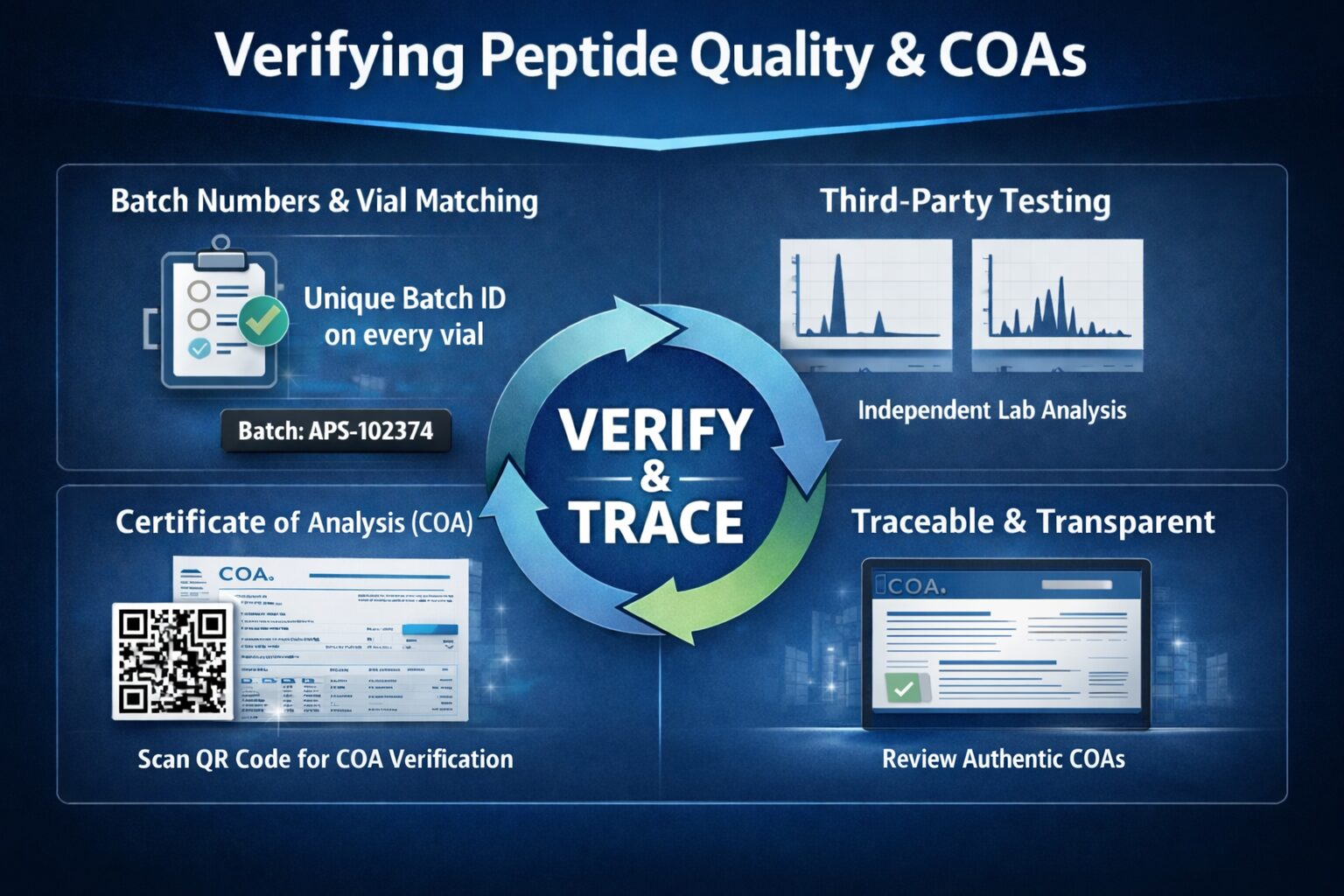
Ruo Coas Include:
The purity percentage comes from comparing the location of the primary height to the total location of all identified peaks. Most records consist of a table listing each peak's retention time, area, and portion of overall location. Finding a reliable resource for biochemical substances is the most crucial action in guaranteeing the stability of any laboratory research study. Imaginative Proteomics gives peptide purity evaluation utilizing logical reversed-phase HPLC combined with mass spectrometry. They use MALDI-TOF MS and other mass spectrometry options routinely. Mass spectrometry (MS) verifies peptide identity by gauging molecular weight. The technique determines the exact mass of the peptide, which functions as a molecular fingerprint. If the determined mass matches the expected mass for your peptide series, you have verification that the appropriate compound is present. And the only way to recognize what you're really getting is through correct logical screening. Choosing the right outside research laboratory for peptide screening includes evaluating several factors. A relied on laboratory must have verifiable experience in peptide chemistry evaluation-- for instance, PhD-level drug stores or biochemists on personnel who understand peptides' synthesis and degradation pathways. Certification by appropriate bodies (such as ISO/IEC or certification for GLP/GMP conformity) is a strong indication of quality. A certified laboratory adheres to strict guidelines for examination precision and approach validation. You can frequently inspect if a laboratory is recognized via its internet site or documents; certification makes sure the laboratory's protocols and outcomes are held to global standards. Palmetto Peptides gives batch-specific COAs with third-party HPLC and mass spectrometry information for all research peptide items. 
❧